Cleveland Way
This 9 day walk is our recommended itinerary covering in the whole of the Cleveland Way as it allows you to walk the entire route with comfortable daily distances.

Itinerary
| Day | Itinerary | Miles | Km |
|---|---|---|---|
| Day 1 | Travel to Helmsley for your first nights accommodation | ||
| Day 2 | Helmsley to Kilburn | 11 | 18 |
| Day 3 | Transfer to Sutton Bank then walk to Osmotherley | 12 | 19 |
| Day 4 | Osmotherley to Clay Bank Top then transfer to Great Broughton | 11 | 18 |
| Day 5 | Transfer back to Clay Bank Top, walk to Gribdale Gate then transfer to Great Ayton | 12 | 19 |
| Day 6 | Transfer back to Gribdale Gate then walk to Saltburn-by-the-Sea | 13 | 21 |
| Day 7 | Saltburn-by-the-Sea to Runswick Bay | 12 | 19 |
| Day 8 | Runswick Bay to Robin Hood’s Bay | 14 | 23 |
| Day 9 | Robin Hood’s Bay to Scarborough | 14 | 23 |
| Day 10 | Scarborough to Filey | 11 | 18 |
| Day 11 | Depart from Filey after breakfast |
Prices
| Accommodation, map & guidebook only | £1155 |
| with Luggage Transport | £1335 |
| with Packed Lunches | £1263 |
| with Luggage & Lunches | £1434 |
Other Options |
|
| Extra Nights (per night) | £104 |
| Single Supplement (per night) | £90 |
| Solo Luggage Supplement (per day) | £18 |
Helmsley to Osmotherley
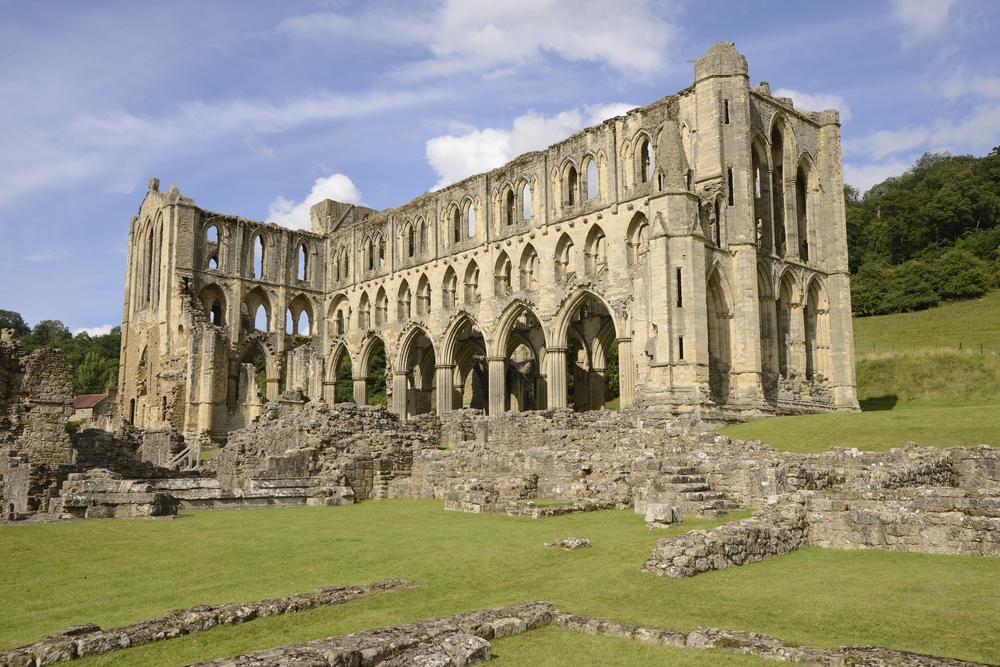
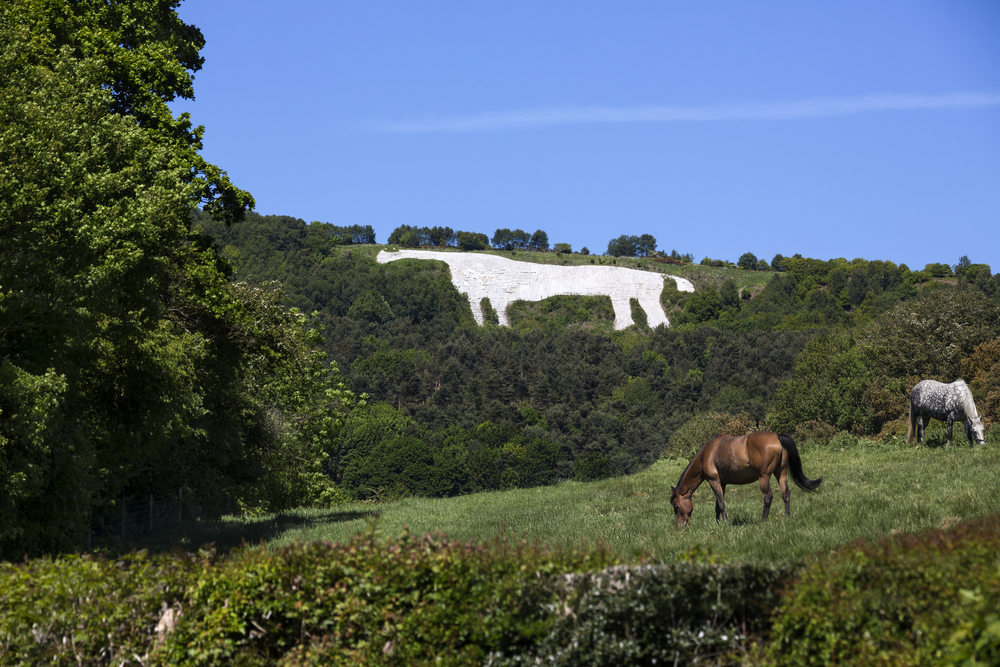
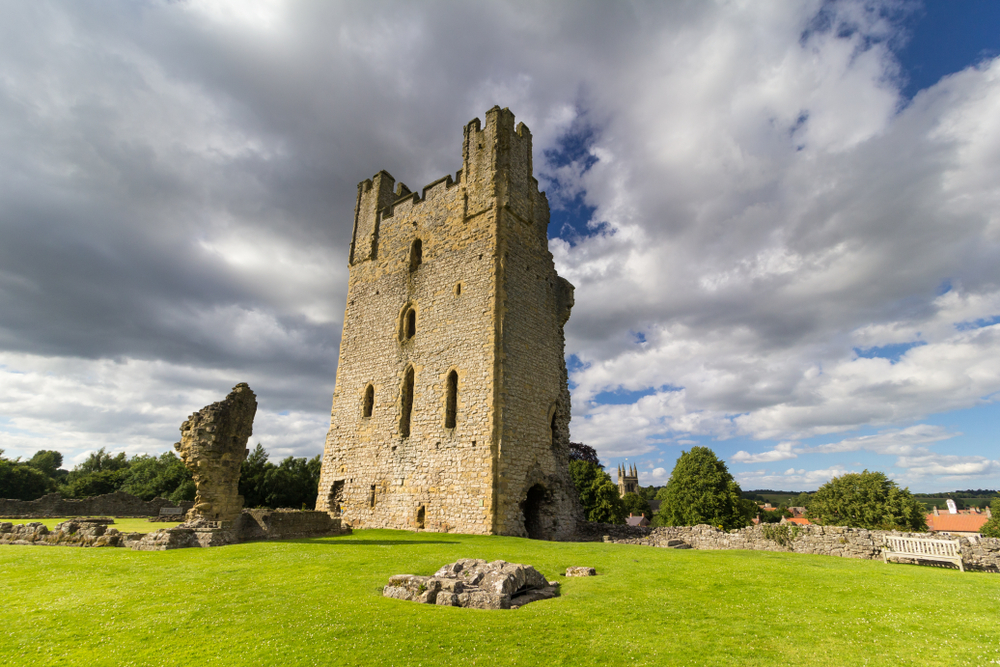
The first section of the Cleveland Way provides an easy woodland walk across the beautiful landscape of the Rye Valley, passing the ruins of Helmsley Castle and later the medieval Rievaulx Abbey. These ruins are among the most beautiful in England and the dense wooded valley of the river Rye provides a magnificent setting. The walk then rises gently to the flat limestone plateaux of the Tabular Hills. It is also worth allowing time to visit the Kilburn White Horse, just before Sutton Bank.
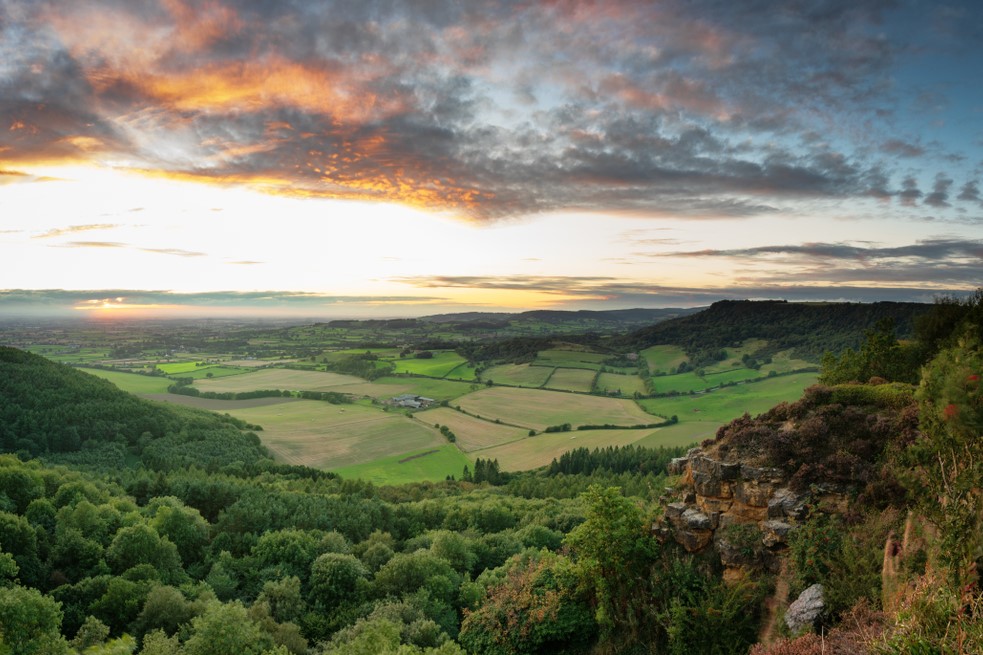
From Sutton Bank the walk is relatively flat, following the western edge of the Hambleton Hills overlooking the Vale of York. The views from Sutton Bank are breathtaking. From High Paradise to Black Hambleton the route follows the old road used by the cattle men (drovers) in earlier centuries. After Black Hambleton you drop down to the idyllic setting of Oakdale’s reservoirs, en route to Osmotherley.
Osmotherley to Kildale
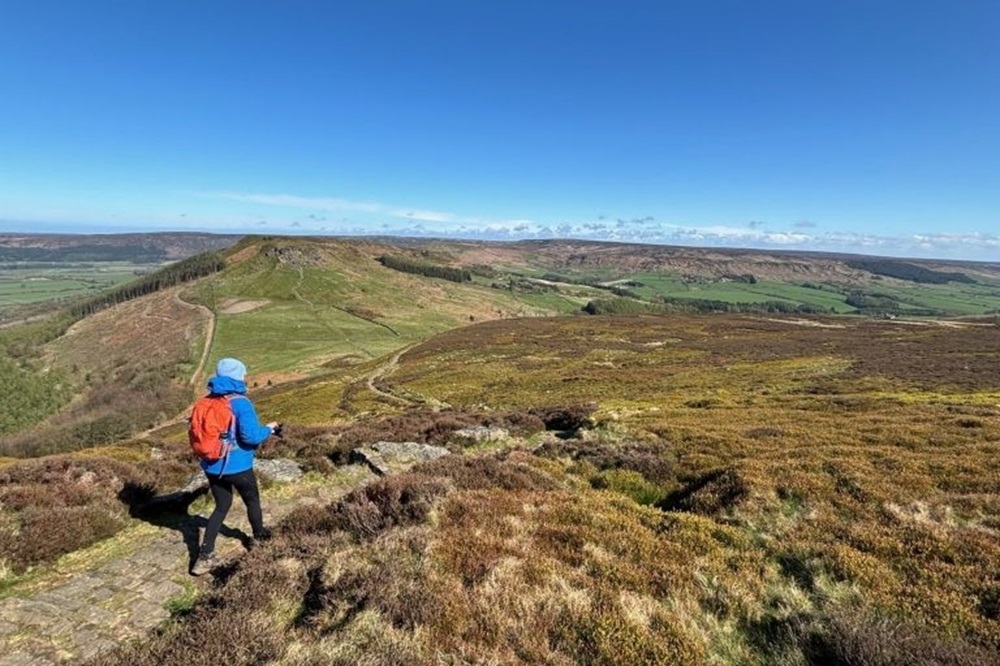
This is the most strenuous section of the trail, as the route follows the northern escarpment of the moors, broken by a series of valley’s cutting into the uplands between Huthwaite Green and Clay Bank Top. The views are stunning over the coastal plain to the North and across the bleak moorland and deep valleys to the South.
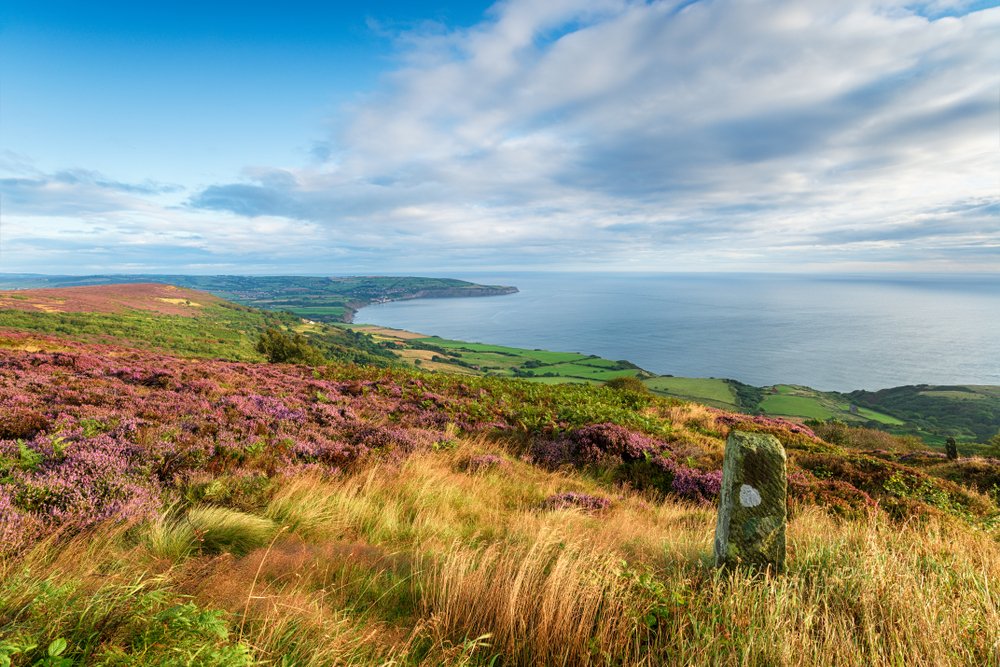
After Clay Bank Top a steep climb leads up to Round Hill, the highest point on the route, where tremendous views can be enjoyed. The route then descends gradually to Kildale which is studded with signs of the past – waymarkers, boundary stones and burial mounds.
Kildale to Saltburn-by-the-Sea
The first part of today’s walk is dominated by an ascent of Easby Moor, to Captain Cook’s Monument, and then the moorland ‘Matterhorn’, Roseberry Topping. Although only 1000ft (300m) high, this distinctive conical hill is prominent in the landscape. From the top the views are excellent. Gentler farmland, woodland and a riverside path lead onto the coast at Saltburn-by-the-Sea.
Saltburn-by-the-Sea to Robin Hood’s Bay
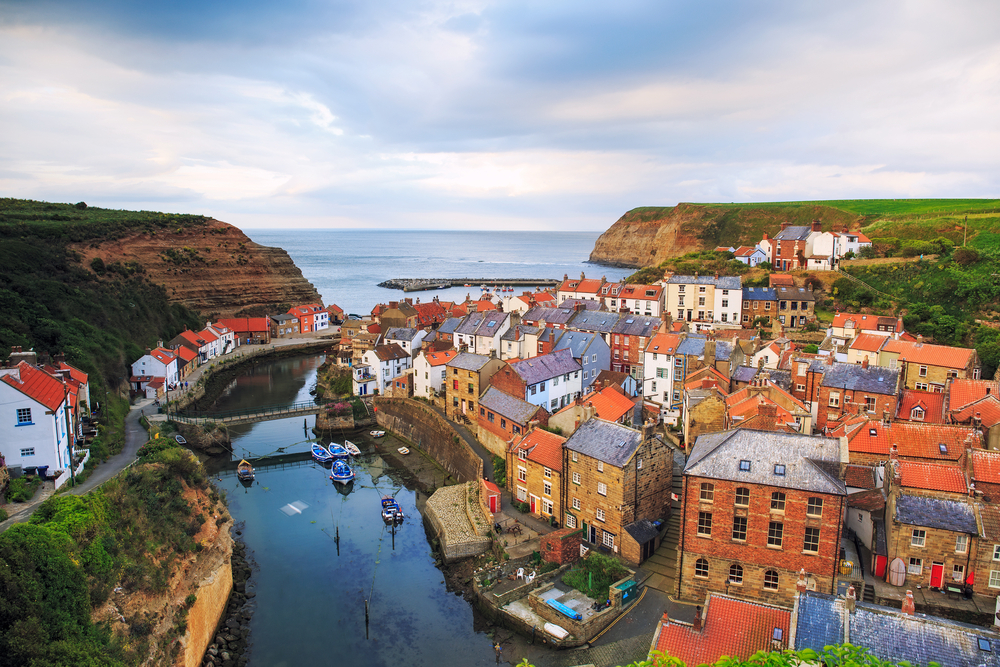
From here on the route hugs the coastline, through historic fishing villages, over high cliffs and along windswept beaches. From Saltburn the route heads up Hunt Cliff and along a section of dramatic cliffs to the highest point on the east of England at Rock Cliff. This route takes you down to sea level on three occasions and through the pretty villages of Staithes and Runswick, ending at the fishing village of Sandsend.
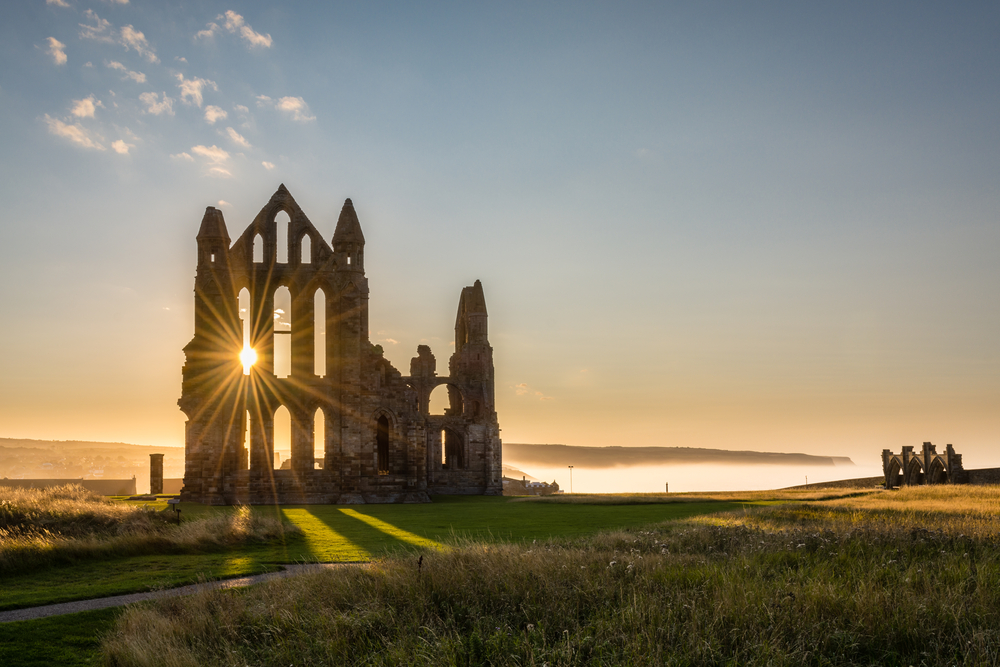
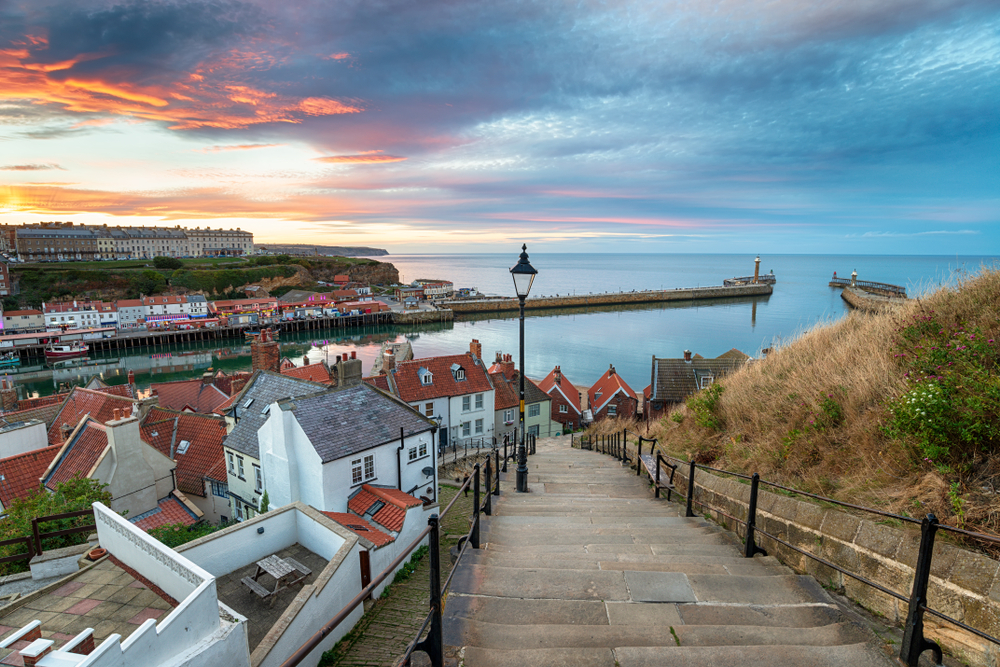
Dramatic coast paths lead onto Whitby, with its fine harbour, fossil filled cliffs and old town connections with Bram Stoker’s Dracula! A visit must be made to the imposing remains of Whitby Abbey high above the town.
Whitby and Robin Hood’s Bay are separated by an easy cliff top walk.
Robin Hood’s Bay to Filey
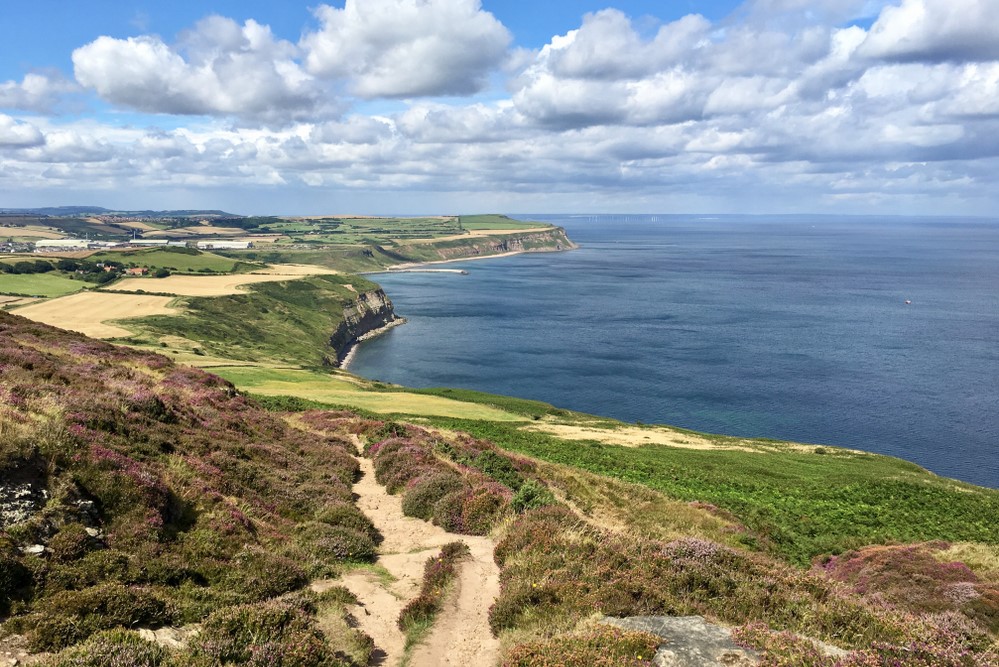
Between Robin Hood’s Bay and Scarborough the route encompasses ever-changing scenery, with the Flyingdales Moor to the west and the North Sea to the east. There are three steep descents and ascents along this path, where the sea interrupts the cliff top walk.
The arrival into the seaside town of Scarborough will provide you with another type of scenery, with its grand beaches, swish hotels and traditional seaside entertainment!
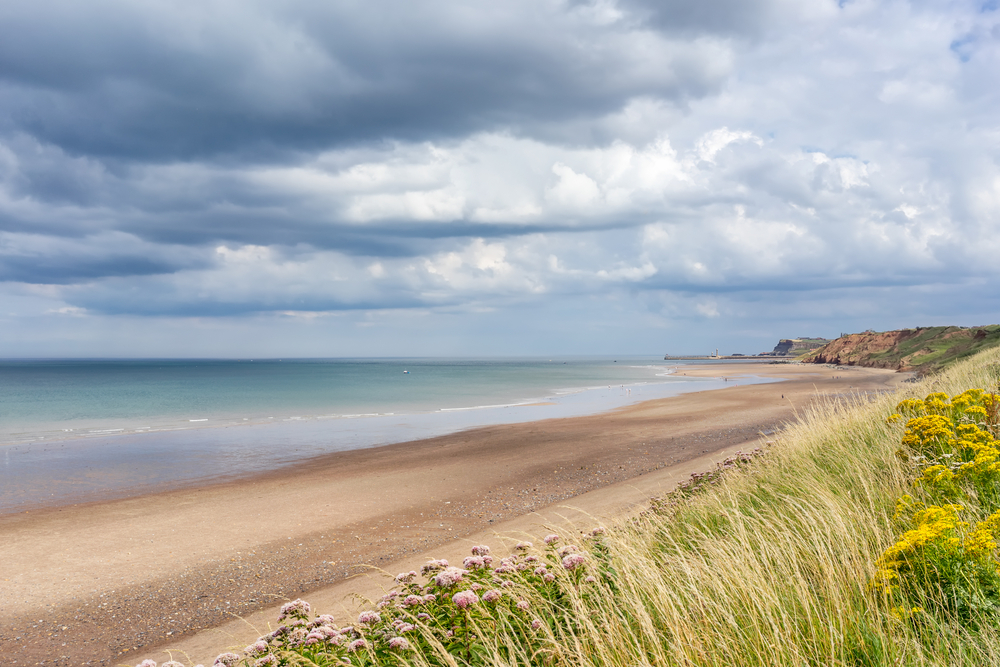
On leaving Scarborough, notice the vibrant colours from the South Cliff as you make your way to the final cliff top trail. The view of continuous coastal cliffs continues from Cayton Bay until your final destination, Filey.
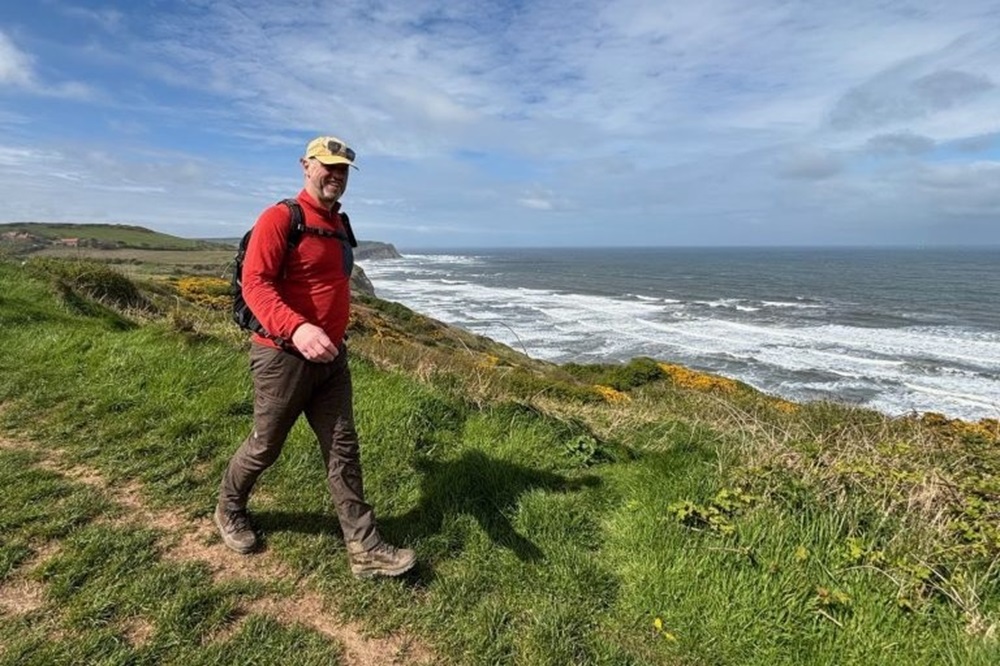
The Cleveland Way features rolling countryside and moorlands, but not mountains. If you are a regular walker this route should be within your capability.
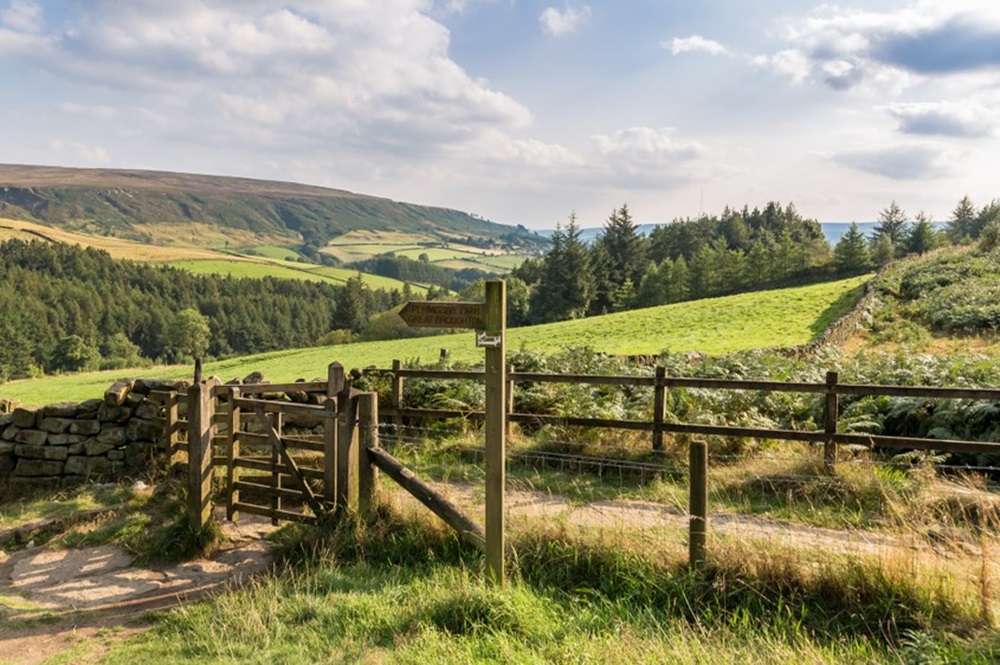
Terrain: A walk of two halves – the North York Moors are rolling, sometimes remote, and up to 1000 feet (300m) high. The coastal path follows the cliffs with frequent descents to coves and beaches.
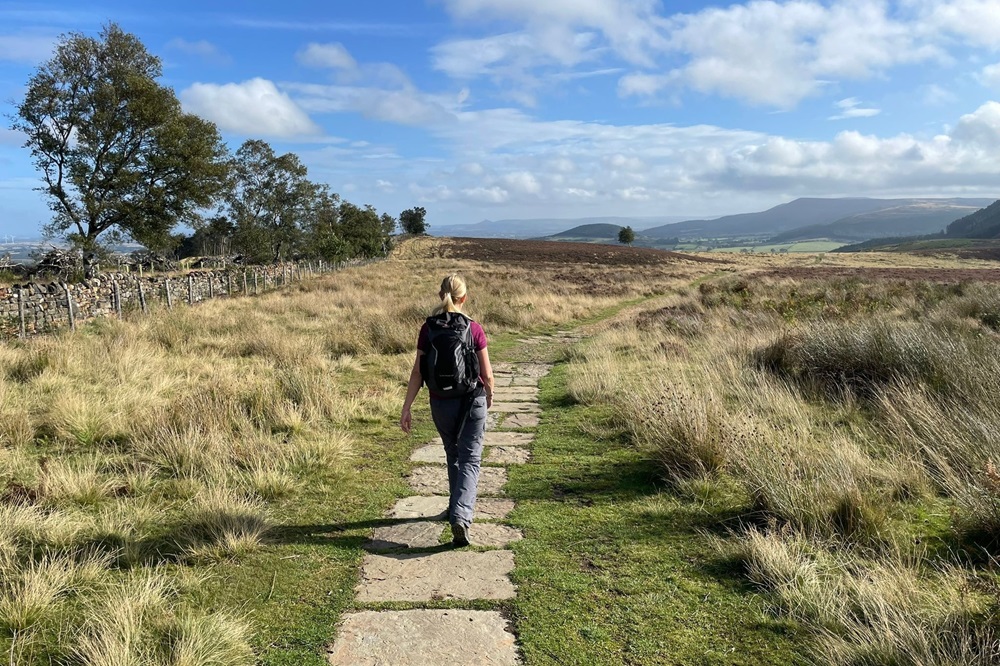
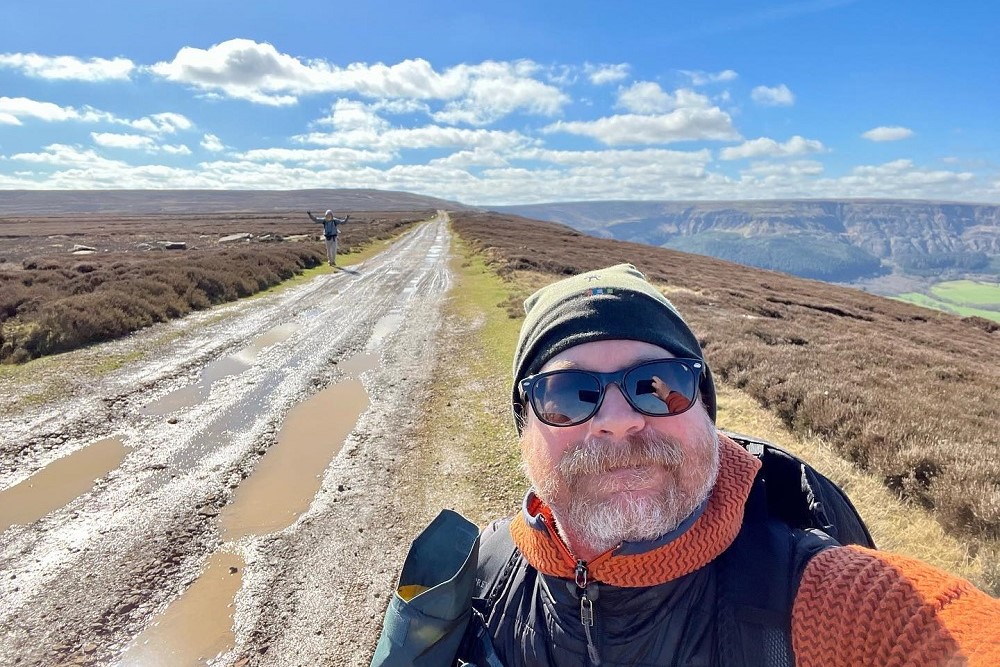
What’s it like underfoot? On the whole the paths are well defined and maintained, but at times it can be rough underfoot with some muddy paths, so good footwear is essential.
How much up & down? There are climbs of up to 1000 feet (300m) some of which can be quite steep, through the Moors section, and short, sometimes steep climbs from sea level along the coast.
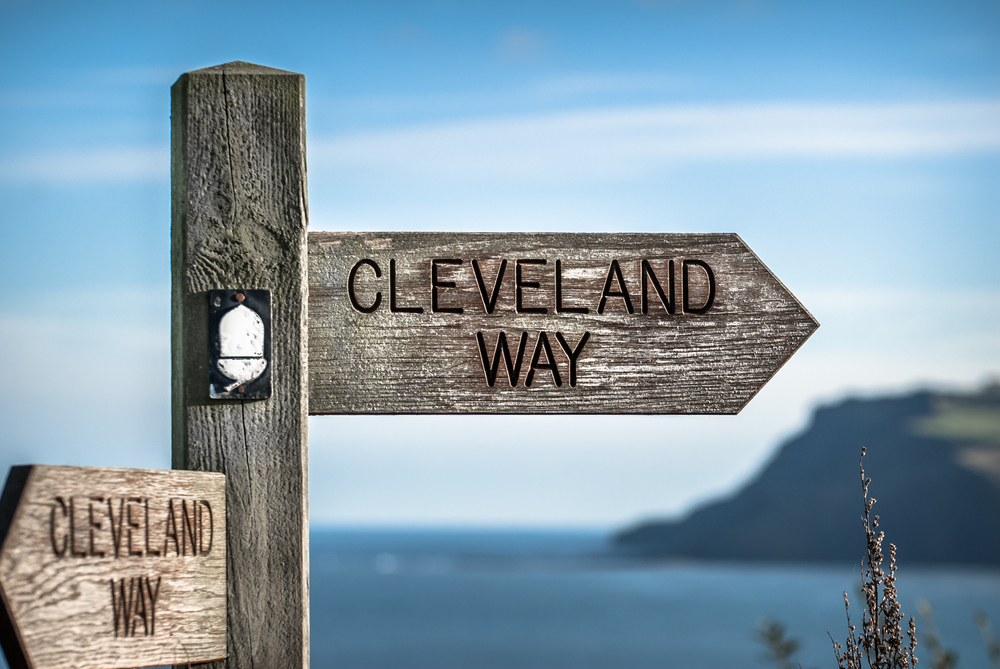
Signposting: Generally good.
Navigation: Pretty straightforward, but you may encounter hill fog or low cloud on the North York Moors, so make sure you can navigate.
Weather: You may be lucky enough to encounter warm, dry weather over the whole route and enjoy dry paths and tremendous views, but you must be prepared because the weather can change quickly. Good clothing including comfortable footwear and reliable waterproofs are essential.
|
All Holidays
|
|
| Accommodation | Overnight Bed and Breakfast accommodation in selected hotels, farmhouses, village inns, guest houses and family B&Bs. Full English or Continental breakfast. |
| Guidebook | A detailed guidebook with route information, maps, photos and background information. |
| Information of Services Along the Route | A comprehensive Service Info sheet, including services such as cash points, banks, post offices, village shops, inns, cafes and taxis. |
| Maps | Three (1:25,000) Ordnance Survey Explorer maps, including mobile download, covering the route. |
| Personal Itinerary | A personal itinerary setting out each overnight stop, including large scale maps of each accommodation, to ensure you find it easily. |
| Emergency Telephone Support | If you get in to difficulties during your holiday, we are always available to help, even out of office hours. |
|
Options
|
|
| Luggage Transport | We will transfer your luggage between each overnight stop – if you leave your luggage at the accommodation when you set off in the morning, it will be moved on to your next B&B. You only need to carry a small day sack with the clothes and provisions you require during the day’s walk. |
| Packed Lunches |
Provided for each day’s walking and recommended on this holiday as there will not always be a handy shop or cafe on the route. |
| Off Road Parking | If you are travelling by car we can usually arrange off road parking for the duration of your trip. (There may be a small charge for this). |
| Arrangement of return transport | We can also arrange your transfer back to your car, (or advise you when public transport is a better option)! |
|
What’s not Included
|
|
| Evening Meals | Your evening meal isn’t included in the package, but we include full details and recommendations for each evening meal in your itinerary. You will normally be within walking distance of a pub and/or restaurant, or where there is good food available at the accommodation, we’ll book that for you. Allow about £30.00 per night. |
| Transport to the Start & Away from the Finish | Have a look at the ‘Travel Info’ tab above for suggestions. If you’re still struggling, get in touch and we’ll help you sort it out. |
| Travel Insurance | Even if you are based in the UK travel insurance is worth having. |
Good accommodation and friendly hosts are an essential part of any holiday. We understand this and go out of our way to find the best. We put a great deal of effort into hand picking our accommodation and matching it to individual customer requirements. As well as visiting the accommodation ourselves, we ask all our customers to complete a short evaluation on each night’s accommodation, which then gives us an insight into the day-to-day operation and lets us spot any potential issues before they become a problem.
We use a variety of accommodation. Over the course of your trip you might stay in a village inn, a bed and breakfast in a converted barn, a Victorian guest house, or on a working farm. In selecting the accommodation we look for helpful, friendly hosts with good quality, characterful accommodation close to the trail. Occasionally we may use a chain hotel.
We always try to arrange en suite accommodation, i.e. rooms with their own bathrooms for each night of your stay. However, in some of the more remote locations accommodation is limited and occasionally we may have to book rooms with shared bathrooms for one or two nights of your holiday, (especially if the booking is made at short notice), but we will always let you know if this is likely to be the case.
We are happy to book single rooms on our holidays but cannot normally book more than two for any one group. Single room bookings include a supplement.
Here are some examples of the accommodation we use on the Cleveland Way:
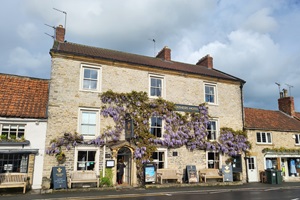 The Feathers Hotel, a 16th-century coaching inn in Helmsley, offers more than just a place to stay. Guests can enjoy cosy fires in winter, a spacious courtyard in summer, and exceptional seasonal menus showcasing the finest flavours of North Yorkshire and beyond, all in a warm and welcoming atmosphere. Visit their website
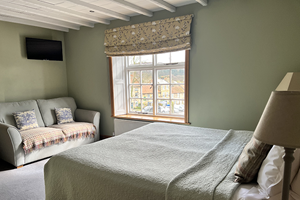 The Golden Lion in Osmotherley, set in the heart of the picturesque North York Moors National Park, is a historic inn with a warm, traditional charm. Popular with both locals and visitors, it offers classic pub fare, real ales, and fine wines. Comfortable, stylish rooms provide the perfect retreat after a day exploring the area’s stunning surroundings. Visit their website
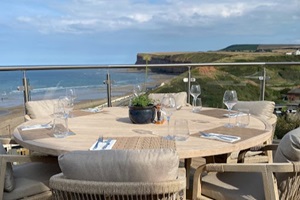 The family-run Spa Hotel in Saltburn offers breathtaking panoramic views of Huntcliff, the North Sea, and the surrounding countryside. Guests can enjoy spacious, comfortable rooms, many with stunning sea views. For ultimate relaxation, the Amber Rooms provide soothing massages and revitalising facials, making it the perfect seaside retreat Visit their website
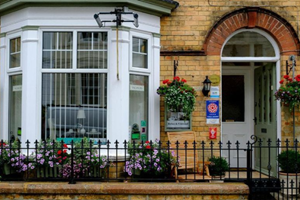 Wendy & Gareth offer you a warm & friendly welcome to The Forge Guest House in Filey. Their delightful property is perfectly situated in a quiet location with the wonderful golden beach, cliff top walks, cafes, restaurants & pubs, only a few minutes stroll away. Visit their website
General travel information on the Cleveland Way area will be in your holiday pack including train and bus timetables where available.
Detailed instructions on getting to your first night’s accommodation by car, or on foot from the nearest train or bus station, will also be included in the holiday pack on individual accommodation maps.
To view train times please visit trainline where you can also purchase tickets in advance. For information on bus timetables please visit traveline
If you require secure car parking whilst walking this route, we can usually arrange this in Helmsley. To return to your car we recommend using a taxi transfer as the journey by public transport is not very convenient and takes a long time.
Getting to Helmsley:
By Air: The nearest International Airport is Leeds Bradford (LBA), from where you can travel by train to Malton (approx 55 mins), then take a taxi to Helmsley (approx 30 minutes). You can also fly to Newcastle (NCL) or Manchester (MAN) – from either of these airports you can take the train to Thirsk, then take a taxi to Helmsley (approx 25 minutes).
By Public Transport: While Malton is the nearest railway station, the most convenient railway stations for Helmsley are York and Scarborough. York is located on the East Coast Main Line with fast and frequent services to London, Edinburgh, and Newcastle. Scarborough is on the Hull–Scarborough branch line with connections to the East Coast Main Line at York. Travel onward to Helmsley by local bus or taxi.
By Road: Helmsley is located on the A170, just off the A19. From York, follow the A64 and then the A170 eastbound. From Scarborough, take the A170 westbound. The town is well signposted from both routes.
Returning from Scarborough:
By Public Transport: Scarborough Railway Station is a northern terminus with regular services to York, where you can connect to the East Coast Mainline for onward travel to London, Leeds and beyond. There are also direct services to Hull and regional connections across Yorkshire.
By Road: Scarborough is easily reached via the A64 from York, linking to the wider motorway network. The town is also accessible via the coastal A165 from Bridlington.
Returning from Filey:
By Public Transport: Filey Railway Station lies on the Hull–Scarborough branch line, with connections to the East Coast Mainline at York.
By Road: Filey is located on the A1039, just off the A165 between Scarborough and Bridlington.
Robin Hood's Bay
This picturesque village is a hidden gem on the East Yorkshire coast consisting of a maze of tiny streets with individual shops, cafes and pubs. Robin Hood’s Bay has a tradition of smuggling (during the late 18th century smuggling was rife on the Yorkshire coast) and there is reputed to be a network of subterranean passageways linking the houses. The rocks of Robin Hood’s Bay play host to a wealth of Jurassic history and fossilling is a wonderful activity for people of all ages along the huge, unspoilt beach. Likewise, the thrill of finding your first crab or starfish in a rock pool is equally as pleasurable.
Filey
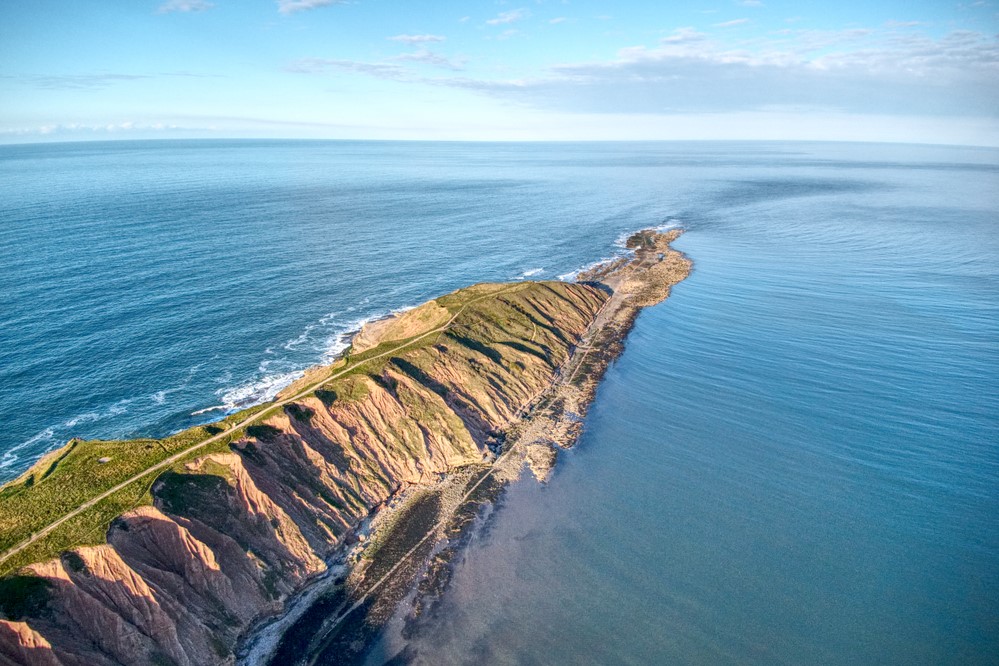
A small, attractive seaside town with a long history of fishing, Filey has a magnificent beach with dramatic views of the long black finger of Filey Brigg in one direction and the chalk headland of Flamborough Head and Bempton Cliffs in the other. It is well worth taking an extra day here to visit the RSPB Reserve at Bempton Cliffs. The Reserve is home to around 200,000 nesting birds including gannets, guillemots and kittiwakes during the breeding season. Just a short distance further along the coast is the magnificent Flamborough Head, one of the best–preserved chalk headlands in Britain and home to the oldest complete surviving lighthouse in the UK.